
Cincinnati, OH and Greater Cincinnati
Pool and Hot Tub Decks in Cincinnati, OH
Surrounds for above ground pools and platforms for hot tubs, both framed for the weight they truly carry, with a surface that does not burn feet or turn treacherous once it is wet.
- Footings below the frost line
- Permits and inspections handled
- Written scope before we start
Cincinnati Custom Decks constructs pool surrounds and spa platforms throughout Greater Cincinnati, framed for the loads water imposes and finished in a surface that stays comfortable beneath bare feet.
Water is heavy, it splashes everywhere, and people cross the result without shoes and while wet. Those three facts dictate every decision on this page.
Platforms for hot tubs
Weight governs the design
A standard domestic deck is engineered to carry roughly 40 pounds per square foot as live load. Set a six person spa on it, fill it and seat the occupants, and the load across that footprint climbs toward 100. No ordinary frame absorbs a jump of that size, and when it fails, it fails without warning.
The spa area therefore stops being ordinary deck and becomes a structural problem in its own right. Closer joist spacing beneath the tub, a beam directly under it, and bases positioned and sized for that concentrated load rather than dropped onto the general grid. On sloping ground around Anderson Township those bases also have to reach below the frost line so the platform does not rise during a hard winter.
Reaching the equipment
Every spa contains an equipment bay that somebody must eventually reach. We incorporate a lift out decking panel or a hinged access hatch on the service side as we build. Without that, somebody ends up with a circular saw and a lost afternoon on the day the pump gives out.
Choosing a position
Near enough to a door that January does not decide how often the spa gets used. Kept out of the prevailing wind. Not sited directly under a bedroom window, since the pump runs overnight. Recessing the tub flush with the decking looks far better than leaving it standing proud, and it carries a higher price, since the frame must step around it and the drainage beneath needs resolving rather than ignoring.
Surrounds for above ground pools
Always free standing
The wall of an above ground pool has one purpose, which is to retain water. It is not a beam and not a post, and transferring any share of a deck load onto it is exactly how such walls fail.
The surround therefore rests wholly on its own bases, separate from the pool. We scribe the boards neatly and leave a small gap, so the two look like a single piece when viewed from a chair, though structurally they are independent.
Height and the gate
The completed surface comes level with the top rail, or slightly under it. Wherever the deck gives access to the water, that opening is governed by barrier rules, so the gate hardware must close and latch by itself to the standard your authority has adopted.
Partial or wraparound
Boarding a single side costs only a fraction of running the full perimeter, and it provides what a pool deck is actually used for, which is a place for towels and a firm spot to enter and leave the water. A complete wraparound photographs beautifully and costs two or three times more. It is worth being honest about which of the two you are paying for.
Choosing boards for a wet setting
Capped PVC
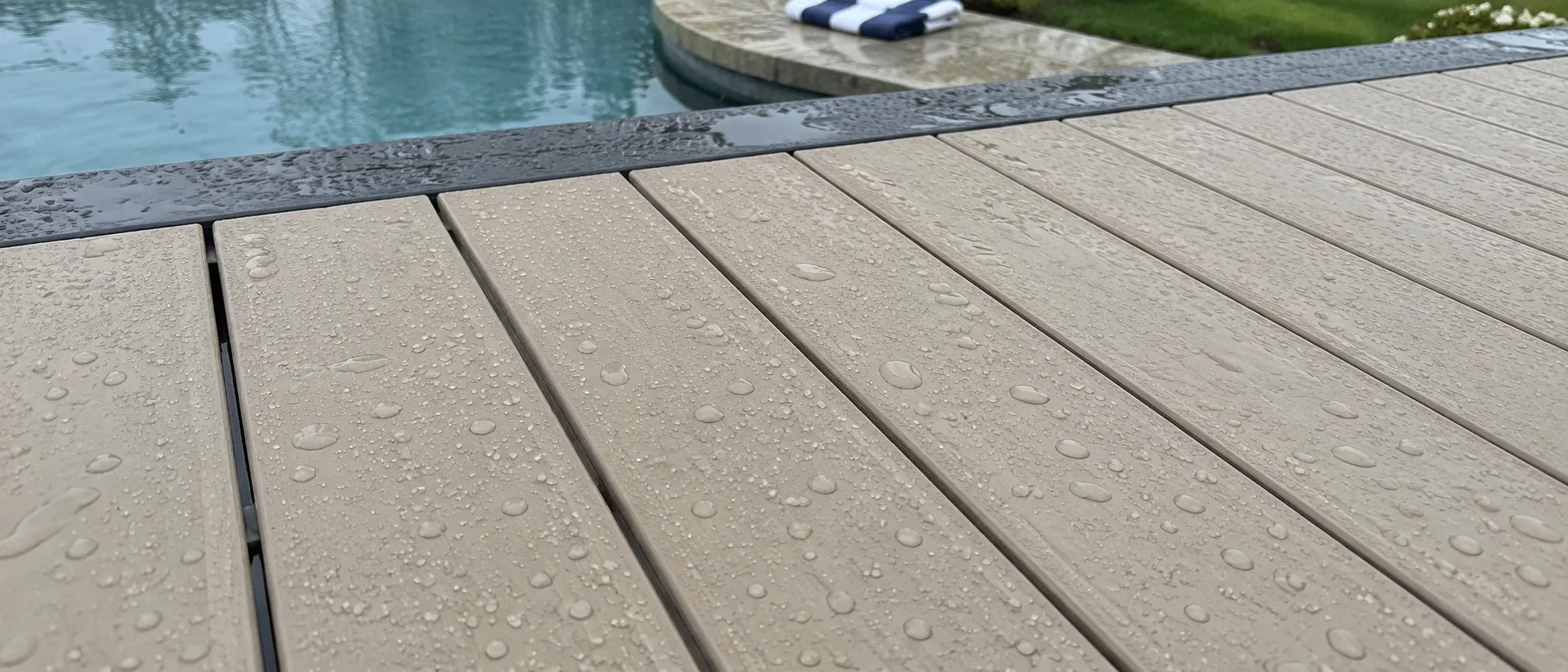
Our top pick for this setting, even though it is the most expensive board we install. PVC is solid throughout rather than a timber core wearing a shell, so water reaching a cut end has nothing to expand. It feels cooler underfoot than wood flour composite, and neither chlorine nor salt affects it.
Mineral core composite
Mineral core boards from the established makers also refuse to take on water and stay cool to the touch. Often cheaper than PVC, and a sound second option.
Timber
Timber looks excellent and performs well, but a pool is the hardest setting in which to keep a timber surface looking that way. Splash out, strong sun and chlorine together wear a finish away far faster than ordinary weather. A timber pool deck is a reasonable choice provided sealing is done on the shorter cycle rather than whenever somebody gets round to it.
Board tone and temperature
Dark boards beside a pool in a Cincinnati August are a mistake nobody repeats. Pale greys and tans feel noticeably cooler barefoot, and on the open unshaded plots around Mason that difference defines the entire afternoon. Before you choose anything, we will point out which way your pool deck is oriented.
Drainage and levels
Water leaves a pool continuously, and every drop has to finish somewhere other than your bases or the rear wall of the dwelling. Grading beneath and around the structure carries it off, and where the deck is raised we look at fitting drainage beneath the deck to capture that water at the joists and pipe it clear. On a ravine plot the outlet matters as much as the collection, because water released down a slope can erode a base further below.
Where we build pool and spa decking
We work in Mason, West Chester, Anderson Township, Blue Ash and Loveland.
Deck cost in Cincinnati, OH
Pick the project, enter the size and finish, then read the installed band our estimators work from before a single call is made.
Why homeowners pick Cincinnati Custom Decks
Footings below the frost line
The Ohio River valley swings above and below freezing all winter. Every post we set lands on a poured footing below the local frost depth, which is what keeps a deck level through a decade of heave and thaw.
Permits and inspections handled
We work out which department your address answers to, pull the permit, meet the inspector and hand you the signed card. An unpermitted deck becomes your problem the day you sell the house.
Written scope before we start
Materials, framing spec, hardware, timeline and price in writing before anybody swings a hammer. No verbal change orders.
Pool and Hot Tub Decks questions we get asked
What sort of weight must a spa platform carry?
Considerably more than an ordinary deck. A six person spa, filled and occupied, commonly reaches around 100 pounds per square foot, while a standard domestic deck is engineered for about 40. That difference calls for closer joist spacing, a dedicated beam directly beneath the tub and bases of its own. Setting a spa on an everyday deck frame is among the riskier short cuts in this trade, and we encounter it more often than we should.
Which boards work best beside a pool?
A board that stays grippy when wet and does not overheat. Capped PVC is the strongest choice, because the material is waterproof throughout, feels cooler than wood flour composite and shrugs off chlorinated water without staining. Mineral core composite comes close. Dark boards, whatever the material, on a pool surround facing south will be too hot for bare feet in July, which rather undermines the reason for having a pool.
Can the deck be fixed to an above ground pool?
It must never rest on the pool wall. That wall performs one job, which is holding the water in. We construct the surround as a free standing deck on separate bases, scribed neatly against the pool so it appears integrated, with a small gap so the two can move independently.
Are fencing and gates required around a pool deck?
Barrier rules are set locally and they govern the whole enclosure rather than the deck alone. Gates that close and latch themselves, latch heights and gaps beneath the barrier are all set out in those rules. We design around the requirements that apply to your jurisdiction and point out anything on an existing enclosure that would fail, which is far better discovered now than at inspection.
Does chlorine or salt harm the decking?
Splash out is unkind to timber, which greys and deteriorates more beside a pool than in any other setting on a property. It also attacks unprotected fixings, and salt systems are harsher still. We specify stainless or heavily coated fixings around pools and normally steer clients toward PVC or capped composite rather than timber, whatever the original budget allowed.
Can an in ground pool be surrounded with decking?
It can, though the detail at the coping decides whether the job succeeds. The deck must not impose load on the pool shell, water has to be carried clear of the structure rather than beneath it, and the meeting of coping and decking must be flush enough to walk on safely without shoes. It is a more demanding build than a standard deck, and we price it as such rather than discovering the difficulty halfway through.