
Cincinnati, OH and Greater Cincinnati
Deck Repair in Cincinnati, OH
Boards that have gone soft, a frame that springs, a guard that shifts the moment you lean on it. We establish what is genuinely failing, tell you whether repair or replacement is the sounder spend, and correct it properly.
- Footings below the frost line
- Permits and inspections handled
- Written scope before we start
Cincinnati Custom Decks repairs decks throughout Cincinnati and Greater Cincinnati: decay, guards that move, footings that have heaved and stairs that no longer pass.
The value of a repair visit sits in the diagnosis rather than the carpentry. What matters is which of those faults you actually have, and whether the frame still justifies spending on it.
What gives out on a Cincinnati deck
The attachment at the house wall
Everything starts where the deck joins the building. A ledger that was face nailed and left without flashing lets water track behind it into the rim joist winter after winter. That joint is behind a large share of the deck collapses on record, it is invisible from above the boards, and it is the first thing we open on any visit.
On the older walkout houses in Blue Ash and the tree covered ridgelines of Anderson Township it appears more often than anywhere else, purely because of the era those frames were built in.
Supports that were never true footings
Concrete deck blocks sitting on the surface, or posts dropped into a bored hole and backfilled with soil. Both seem to behave for a winter or two. Then the freeze and thaw swing of the Ohio River valley lifts one and settles another, the frame racks out of level, the board gaps open and the guards work loose. Heavy expansive clay makes it worse, because the ground itself swells and shrinks with the water it holds. Setting a real footing below the frost line is disruptive, and it is the only repair that lasts.
Decay at post bases and beam ends
Anywhere cut end grain rests against concrete or soil, and anywhere a beam end sits in a pocket that traps water. A post can read as solid at hip height and be punky in the bottom inch. We probe the timber rather than trusting how it looks.
Decay along the top of the joists
The upper face of a joist holds standing water at every fastener. Frames assembled without protective tape on the joist rot downward from that edge, and the first clue is usually a spongy patch underfoot rather than anything you can see.
Guards that rock
Posts driven through the decking instead of bolted to the frame, or notched so deeply that very little section survives. Code expects a guard to resist a genuine lateral force at the top rail. A guard you can shift with one hand cannot meet that.
Stairs
Risers of differing heights, no graspable handrail, a bottom tread landing on bare soil, stringers cut so deep that barely any timber is left. A stair carries the heaviest traffic on the deck and receives the least attention, and on the long runs above a ravine lot the cost of a bad step is higher than it looks.
How the assessment works
We walk the surface first, then go underneath. That means posts, footings, bearing at the beams, joist condition, the type and corrosion of the hangers, how the ledger is fixed and flashed, the guard attachment and the geometry of the stair.
You receive a plain list: what is failing, what is urgent, what can wait a season, and what each item costs. No photographs of somebody else’s collapse, only your deck.
Where the frame has reached the point that repair no longer pays, we say so and price a replacement instead. That answer is harder to give and the job is larger, and finding it out midway through helps nobody.
The repairs we carry out most
New surface boards
Lifting failed decking and laying new, either matched to what is there or moving to composite over the same frame. Where the frame is genuinely sound this is the strongest value on the page, because it renews the part you see and touch for roughly a third of a rebuild.
Structural correction
Sistering joists, adding a mid span beam and footings to remove bounce, swapping out rotten posts, restoring bearing beneath a beam, and replacing hangers that were fixed with the wrong nail. The copper in modern treated lumber attacks plain steel, so many older frames carry hangers doing far less work than they appear to.
Ledger correction
Removing the trim, exposing the joint, replacing the ledger where it has decayed, bolting it correctly and flashing it to shed water. If the rim joist behind it has softened, that is repaired first. It is not a cheap fix and it is not one you can postpone.
Guard rebuilds
Returning guards to the required height and opening size, with posts fixed to the frame using hardware made for the load rather than driven through the decking. This is usually the moment to move to aluminium and stop repainting for good.
Stair rebuilds
New stringers, an even rise on every step, a proper landing at grade rather than bare earth, and a handrail a hand can actually close around.
Repair first, then protect the timber
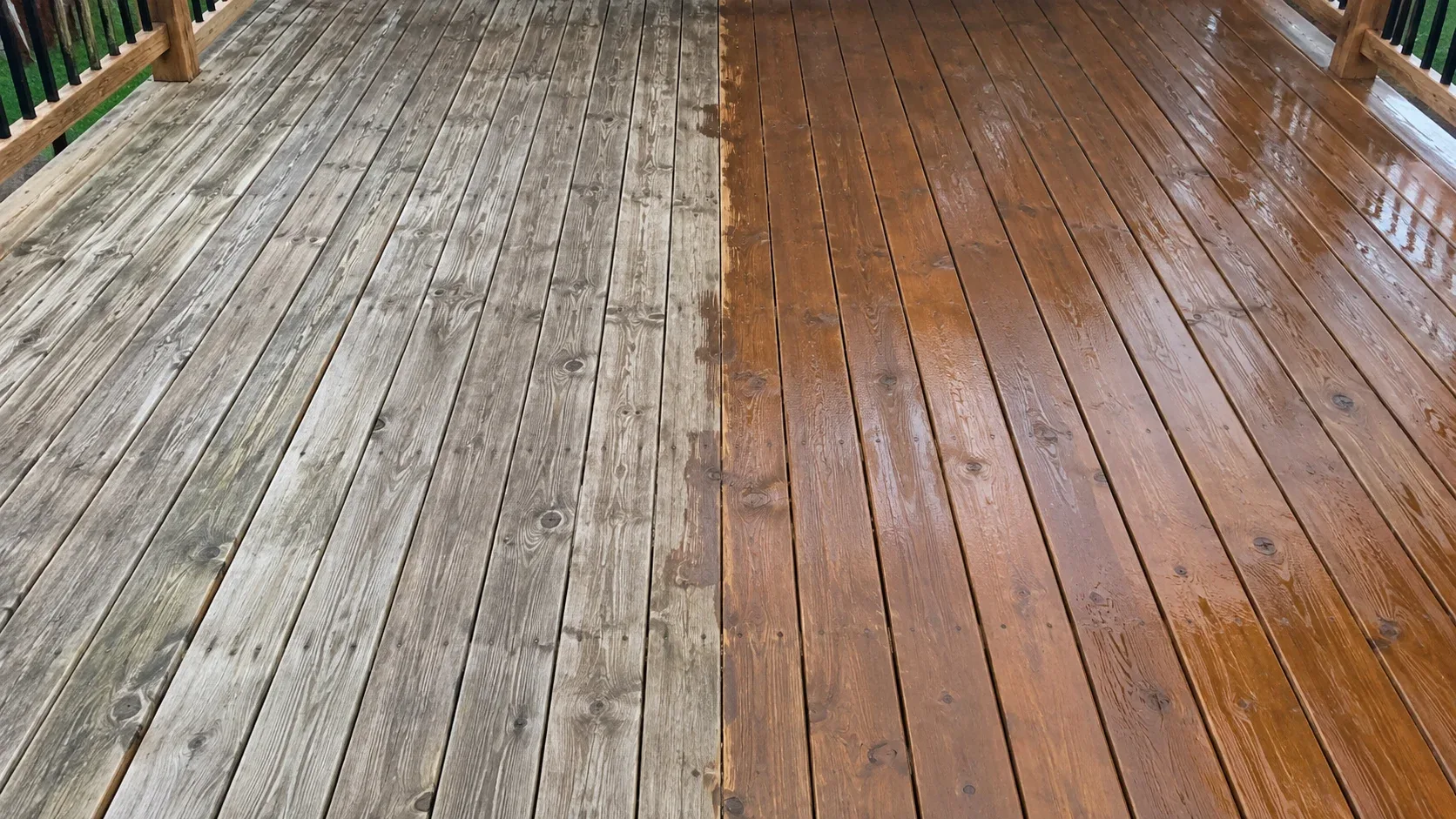
A repaired wood deck that goes back into use without a finish returns to us inside four years, and not in a state either of us enjoys. Once the structure is sound, put a coating on it.
Our staining and sealing page sets out the schedule and the cost. Measured against what it prevents, it is the least expensive item on this site.
Where we repair decks
Across Cincinnati and the five communities we serve: Mason, West Chester, Anderson Township, Blue Ash and Loveland.
The calls differ with the ground. In the newer West Chester subdivisions the frame is usually healthy and the builder grade surface has simply run its course, which is a far happier conversation than the one about a rotten ledger. On the wooded ridgeline lots of Anderson Township the reverse is common, because shade keeps the framing damp and the canopy drops debris that holds water against the wood.
Deck cost in Cincinnati, OH
Pick the project, enter the size and finish, then read the installed band our estimators work from before a single call is made.
Why homeowners pick Cincinnati Custom Decks
Footings below the frost line
The Ohio River valley swings above and below freezing all winter. Every post we set lands on a poured footing below the local frost depth, which is what keeps a deck level through a decade of heave and thaw.
Permits and inspections handled
We work out which department your address answers to, pull the permit, meet the inspector and hand you the signed card. An unpermitted deck becomes your problem the day you sell the house.
Written scope before we start
Materials, framing spec, hardware, timeline and price in writing before anybody swings a hammer. No verbal change orders.
Deck Repair questions we get asked
How can I tell whether my deck is unsafe?
Five checks you can carry out yourself. Press hard against the top of the guard and watch for movement. Look along the line where the deck meets the wall for rust stains, a widening gap or timber that gives under a screwdriver. Walk the surface and listen and feel for spring underfoot. Go underneath and examine the post bases and anything resting on a concrete block. Then look at the stair for a tread that sits lower than its neighbours. Any single one of those is reason enough for an inspection, and the attachment at the house is the fault that actually drops decks, because it is the one nobody can see from standing on the boards.
Is a repair cheaper than a replacement?
The frame answers that question and nothing else does. Where the joists, beams, posts and ledger are sound, renewing the surface and the guards costs roughly a third of a rebuild and buys another fifteen years of service. Where the frame is undersized, resting on surface blocks or face nailed to the house, repair is money put into a structure that will still have to come out. We open the frame and give you the verdict in writing before any money changes hands, and on the hillside lots around Cincinnati the honest answer is a replacement more often than a homeowner expects.
Can you fix only one part of the deck?
Frequently yes, and it is often the correct call. Five or six decayed boards, one stair run or a single post that has heaved are all ordinary work. New treated timber set beside weathered boards will not match on the day it goes down, but it blends within a season or two once the whole surface has silvered together. We would rather say that at the quote stage than leave you expecting a seamless patch that no material can deliver.
The deck bounces when people walk on it. Is that dangerous?
It normally points to joists that are undersized or spanned too far for the load, or to a beam that has lost bearing at one end. It does not mean the deck is about to drop, but it does mean the frame was built to the wrong span, and the movement grows as the timber ages and dries. A mid span beam with its own line of footings often removes the spring for a small fraction of a rebuild. Expansive clay makes the footing side of that fix more important here than in most markets.
Does deck repair need a permit in Cincinnati?
Swapping boards like for like generally does not. Anything structural does, which covers a new ledger, new footings, a rebuilt stair, altered framing or any added floor area. Which office you deal with follows your address across the four counties we work in. The City of Mason and the City of Blue Ash each run their own building department, West Chester handles permits through its township Community Development office, Loveland has a city Building and Zoning department, and an Anderson Township address involves township zoning plus Hamilton County Building Inspections for the permit itself. Ohio waives a state permit only for a detached deck of 200 square feet or less, no more than 30 inches above grade and not serving a required exit. We confirm the path before work starts rather than after.
How quickly can you come and look?
Inspections and repair quotes usually happen within a few days, and sooner when the deck is genuinely unsafe and you say so on the phone. If what you describe sounds dangerous we will ask you to keep people off it until we have been out, and that advice costs nothing. Cincinnati hillside lots and ravine lots sometimes hide a footing problem that only shows from below, so we always allow time to get under the deck as well as walk it.