
Cincinnati, OH and Greater Cincinnati
Deck Railing Installation in Cincinnati, OH
Guards in aluminium, cable, glass and timber, anchored into the frame the way the code intends instead of being driven down through the decking. This is the part of the build that carries a person's weight and the part an inspector studies hardest.
- Footings below the frost line
- Permits and inspections handled
- Written scope before we start
Cincinnati Custom Decks fits deck railings throughout Cincinnati and Greater Cincinnati in aluminium, cable, glass and timber, anchored to the frame rather than driven through the decking.
A guard is the element of a deck that gets handled most and inspected hardest, and it is where a rushed detail announces itself soonest.
How a guard should be fixed
A guard post belongs on the frame, never on the surface. In practice that means bolting through the rim joist, or through a joist that has been blocked for the purpose, using hardware rated for the load, with blocking installed inside the frame wherever a post is going to land.
With composite decking this has to be settled before any board is laid, because the blocking is fitted during framing and lifting finished decking later is the only alternative. It is one reason we raise the railing question at design stage rather than near the end.
The code requires a guard to absorb a substantial point load applied to the top rail from any direction. That load represents a person falling against it, which is the reason a guard exists at all. A rail that gives when you lean on it has already failed that test.
The systems we install
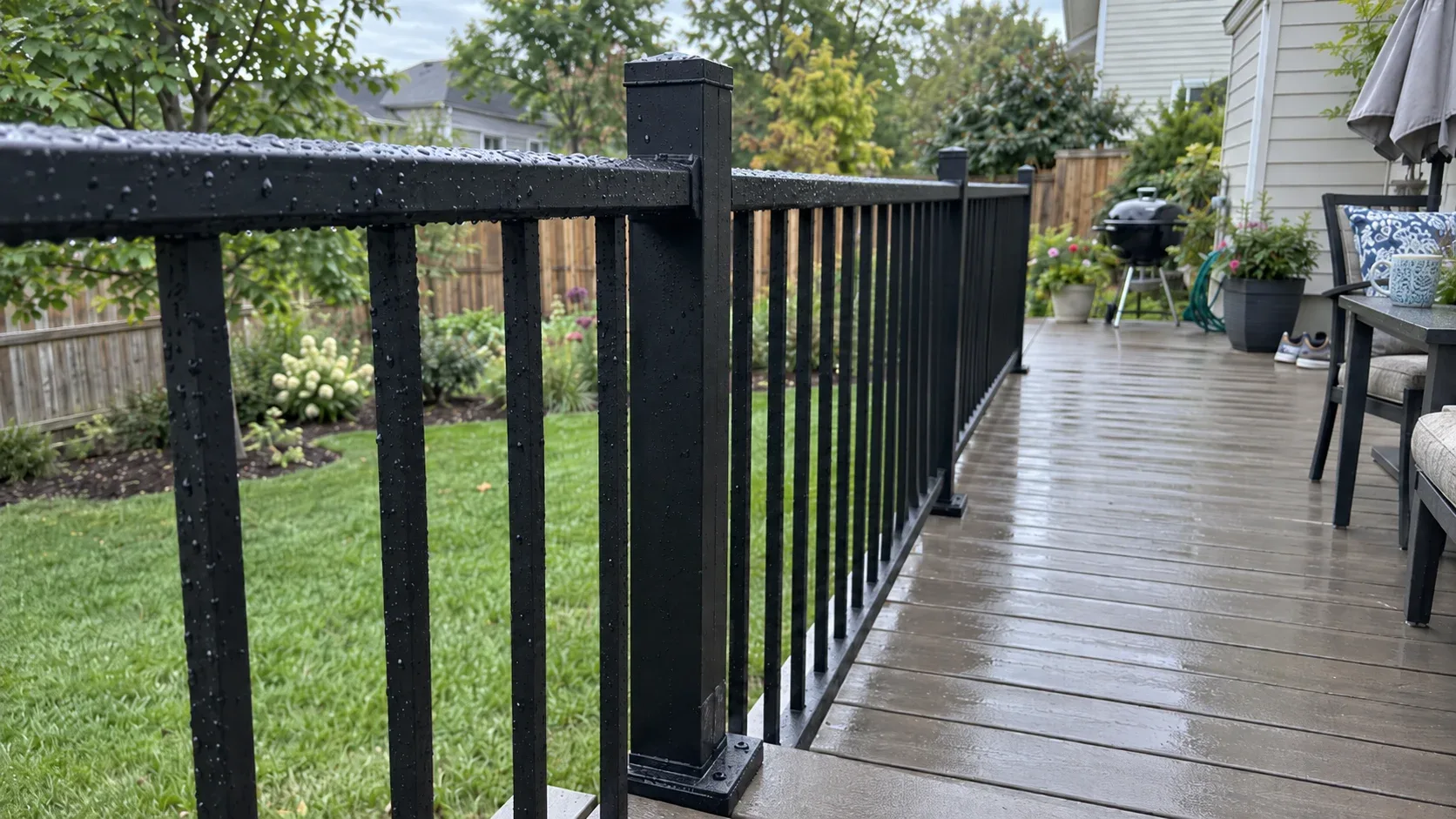
Black aluminium
This is the upgrade most homeowners ask for and the one we fit most. The powder coat will not rust, no repainting is ever required, and the narrow members let the garden read through rather than blocking it.
It suits timber, composite and PVC boards, most ranges take lit post caps, and in newer Mason and West Chester subdivisions it passes association design review without a debate, which has value in itself.
Timber
Treated or cedar, assembled on site. It is the least expensive to put up and the dearest to own. It makes sense on a rustic deck where the money is better spent on floor area, and on an older house where aluminium would look out of period.
Through Blue Ash a painted timber guard colour matched to the window trim often looks better than aluminium, and on a visible elevation that can outweigh the upkeep saving.
Composite rail
Colour matched to the decking and needing no finish at all. It reads heavier than aluminium and usually costs about the same, so the real question is whether you want the guard to blend with the deck or to fade against the view.
Horizontal cable
Stainless strands strung between metal posts, the most open sight line you can get before glass. It demands correct tension, rigid corner and end posts, and a recheck after the first season because cable stretches as it beds in.
Glass panel
Either full panels or infill set between posts. It is close to invisible, and it excels where there is a view or on a windy exposed face where a windbreak is welcome. It does need cleaning, and beneath mature hardwoods that becomes a genuine recurring task rather than an afterthought.
Stairs, handrails and what fails inspection
A handrail you can grip
Every stair of four risers or more needs a handrail that a hand can close around, set at the height the code specifies. A 2 by 6 laid flat across the top of a guard cannot be gripped, and that is the most frequent stair defect we encounter on decks built by homeowners.
Even baluster spacing
The 4 inch sphere rule governs the widest gap anywhere in the guard, and that includes the wedge shaped opening at the foot of a stair guard. The wedge catches people out because it looks acceptable until a tape or a sphere is put to it.
Post spacing
A guard performs only as well as its post spacing permits. Widening the spacing to save a little produces a rail that bows between posts, and a rail that bows is one nobody trusts or leans against, which defeats the whole point.
Cost, and why railing drives the budget
Guards are sold by the linear foot, and a deck perimeter does not grow in step with floor area the way people imagine. A long narrow deck can need twice the guard of a square deck over the same footprint. On an elevated deck with two stair flights, the guard can reach a quarter of the total build cost.
Two decisions follow. The first is that a deck sitting under 30 inches above grade frequently needs no guard whatsoever, which is a sizeable saving and a real reason to hold the deck low wherever the door height allows.
The second is that when money is tight, aluminium on the elevation you actually look at with timber on the rest is a fair compromise, provided it is designed so the mix looks deliberate rather than like the funds ran short.
Retrofitting railings to an existing deck
This is common work, and well worth doing where the boards are still sound and the original timber guards have softened. We establish whether the frame has blocking beneath each new post position, install it where it is missing, and then fit the new system.
Where the old guards were screwed straight through the decking, expect the frame repairs to form a real part of the quotation. The missing blocking is the true job. The railing itself is the simple part.
Where we install railings
Cincinnati and the five communities we cover: Mason, West Chester, Anderson Township, Blue Ash and Loveland.
Black aluminium is the near default in Mason and the newer West Chester subdivisions, cable comes up most on the wooded Anderson Township lots where the outlook is the whole point, and timber still holds its own in Blue Ash because it suits the housing.
Deck cost in Cincinnati, OH
Pick the project, enter the size and finish, then read the installed band our estimators work from before a single call is made.
Why homeowners pick Cincinnati Custom Decks
Footings below the frost line
The Ohio River valley swings above and below freezing all winter. Every post we set lands on a poured footing below the local frost depth, which is what keeps a deck level through a decade of heave and thaw.
Permits and inspections handled
We work out which department your address answers to, pull the permit, meet the inspector and hand you the signed card. An unpermitted deck becomes your problem the day you sell the house.
Written scope before we start
Materials, framing spec, hardware, timeline and price in writing before anybody swings a hammer. No verbal change orders.
Deck Railings questions we get asked
How high does a deck railing have to be in Ohio?
A residential guard stands at 36 inches minimum, measured from the deck boards to the top of the rail, and it becomes mandatory once the walking surface is more than 30 inches above the ground beneath. Gaps must be small enough that a 4 inch sphere will not pass, which is what determines baluster spacing and the size of the triangular opening at the base of a stair guard. Stair guards and handrails follow their own separate rules on height and grip. Your building department confirms the detail for a given address, and on a hillside deck the measurement down to grade is taken at the lowest point rather than an average.
Why does my railing wobble?
Nearly always because the guard posts were driven through the decking into nothing structural, or notched so deeply that barely any post section remains. The code asks a guard to resist a genuine point load at the top rail, and that load stands for a person falling against it. A post fitted correctly is bolted to the rim joist or to a blocked joist with hardware intended for the purpose. Adding proper blocking is ordinary repair work rather than a rebuild, and it is one of the fixes we carry out most often on older decks in [Blue Ash](/blue-ash-oh).
Is aluminium worth the extra over timber?
Across a decade, normally yes. A timber guard offers a vast surface to coat, wants refinishing on the same schedule as the deck, and its balusters will split in the end regardless. Aluminium costs around 50 percent more installed and then asks for nothing. It also reads as visually far lighter, which counts wherever the deck looks out at something worth seeing rather than at a fence, and that is exactly the situation on the wooded ridgeline lots of [Anderson Township](/anderson-township-oh).
Can I have cable railing here?
Yes. Cable must be tensioned correctly and the posts have to be rigid enough and close enough together that no strand can spread past the opening limit. That generally means metal posts instead of timber, with corner and terminal posts sized for the tension load. Executed properly it is excellent, particularly where the outlook over the Ohio River valley is the reason for being out on the deck. Executed on undersized timber posts it fails inspection and will sag as soon as the timber moves.
Do I need a railing on a low deck?
Not where the walking surface remains under 30 inches above the ground beneath, and that is among the strongest arguments for a ground level deck when the budget is stretched. You will still usually want a handrail on any stair of four or more risers, and that is worth having whatever the code says. On a sloping Cincinnati lot the height to grade can cross the threshold at one corner but not another, so the guard requirement is assessed edge by edge rather than for the deck as a whole.
Can you build lighting into the railings?
Yes, and it costs far less during the railing install than after it, because the cable runs inside the posts and rails while they are still open. Post cap lights, under rail strips and recessed riser lights are all routine, and on a long stair above a walkout the riser lights are a safety item rather than a decoration. The [deck lighting page](/deck-lighting) sets out the fittings and how the low voltage supply is arranged.