
Cincinnati, OH and Greater Cincinnati
Deck Lighting in Cincinnati, OH
Cable for riser lights, rail strips and post caps is pulled before the frame closes, so once the deck is finished nothing is on show. The supply is low voltage, dimmable and cheap enough to leave running.
- Footings below the frost line
- Permits and inspections handled
- Written scope before we start
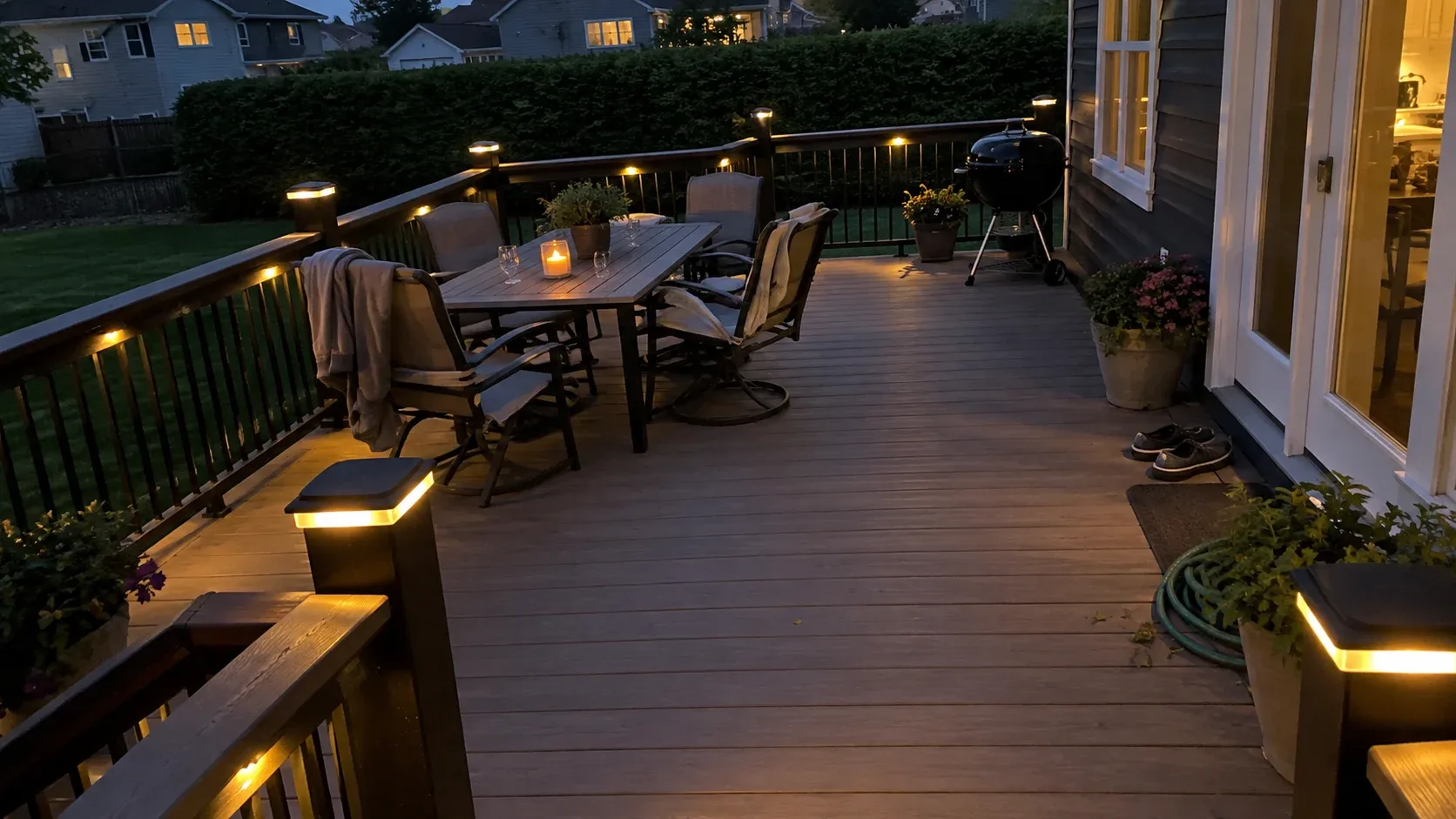
Cincinnati Custom Decks runs deck lighting throughout Cincinnati and the neighbouring hill suburbs, from recessed riser lights and under rail strips to lit post caps, and the cable is pulled while the frame is still open.
The spend is a minor slice of the deck, yet it governs how many evenings the space is actually occupied, which is why it earns a place on nearly every estimate we prepare.
What actually needs lighting
Stair risers
This is the fitting that matters most and gets discussed least. One recessed light per riser, or every second riser, turns a dark flight into something a guest can read at a glance. Safety drives the decision and the appearance is a bonus.
On the long flights that fall away from the hillside and walkout lots in Anderson Township, the riser lights stop being an extra and become the reason the lower level is used after dark.
The perimeter
A strip tucked beneath the top rail washes light down over the boards and marks the edge without drawing the eye to any single fitting. Pound for pound it returns more than anything else here, because an unbroken line outperforms a handful of isolated points.
The posts
Post caps are the lights you notice from the kitchen, so they carry most of the work of making the deck look inviting from indoors. In truth they illuminate themselves more than the floor, and that is precisely the task they should be doing.
The ceiling, where one exists
Under a covered porch or below an under deck ceiling, recessed ceiling fittings become the primary source and they deserve a dedicated switch and dimmer.
How we do it
Low voltage, transformer at the house
A transformer mounted beside an existing exterior outlet reduces the supply to 12 volts. Every fixture beyond it runs at low voltage, which is safe when wet and straightforward to extend. We choose a transformer with spare capacity so later additions do not force a replacement.
Cable run during framing
The cable threads through posts, along the underside of the top rail and behind the riser boards. Any holes are placed where they do not cut into structure, and the cable is secured away from fasteners. That is the whole argument for deciding early instead of late.
Timer or photocell
It switches on at dusk and off at a chosen hour. A system operated by hand gets used far less than one that looks after itself, and across a Cincinnati summer that gap is large.
Zones
On a bigger deck it pays to put the stairs on one circuit and the ambient lighting on another. Riser lights are a safety feature and should be available without illuminating the entire deck.
Getting the look right
Warm, not white
A warm colour temperature feels like firelight and belongs outdoors. Cool white turns the space into a loading bay. That one choice shapes the finished atmosphere more than any other on this page, and getting it right costs nothing.
Dim sources, and plenty of them
A number of soft lights beat a few harsh ones, and they remove the glare that hits anyone seated. Good deck lighting is something you look past, not at.
Leave the yard alone
Floodlights mounted on the house and aimed at the deck ruin the effect and annoy the neighbours, which on the tighter lots through Blue Ash is a practical concern and not merely a courtesy. If security lighting is wanted too, give it a separate circuit and a motion sensor.
Adding lighting to an existing deck
It can be done, and the realistic choices are post caps, surface mounted rail strips and solar fittings. Recessed riser and floor lights need room behind the board, which normally means lifting a riser or a run of decking.
We will say plainly which options will look clean and which will leave something visible, and that is usually a shorter list than people anticipate.
Where we install deck lighting
Cincinnati and the five communities we cover: Mason, West Chester, Anderson Township, Blue Ash and Loveland.
Deck cost in Cincinnati, OH
Pick the project, enter the size and finish, then read the installed band our estimators work from before a single call is made.
Why homeowners pick Cincinnati Custom Decks
Footings below the frost line
The Ohio River valley swings above and below freezing all winter. Every post we set lands on a poured footing below the local frost depth, which is what keeps a deck level through a decade of heave and thaw.
Permits and inspections handled
We work out which department your address answers to, pull the permit, meet the inspector and hand you the signed card. An unpermitted deck becomes your problem the day you sell the house.
Written scope before we start
Materials, framing spec, hardware, timeline and price in writing before anybody swings a hammer. No verbal change orders.
Deck Lighting questions we get asked
Is deck lighting worth it?
Any deck with a flight of steps earns back the riser lights on safety alone, since an unlit stair is where a visitor is most likely to be injured on your property. Past that, it settles whether the deck goes unused once the sun drops or stays in service through the evening, and those late hours are a large part of what a Cincinnati summer is for. The lighting is a minor slice of the overall budget and it governs how often the rest of the deck gets used.
When should lighting be installed?
While the frame is open, ahead of the decking and the guards. Cable travels inside the posts, beneath the rail and behind the riser boards, and once the surface is closed each of those paths becomes awkward and conspicuous. A retrofit is achievable, it simply costs more and seldom finishes as neatly. If lighting is only a possibility on your plan, we pull the cable and cap it, which is inexpensive and preserves the choice.
Is low voltage lighting safe outdoors?
It is, and it is the usual approach on a deck. A transformer at the house reduces 120 volts to 12, and every fitting beyond that point operates at low voltage. It is safe when wet, it escapes the conduit and burial depth requirements that line voltage brings, and a failed fixture is cheap to swap. The transformer is selected with spare capacity so additional lights can be added without replacing it.
How much does it cost to run?
Very little. A complete LED system generally consumes less power than one old incandescent lamp. Set on a timer or a photocell it comes on at dusk and switches off at a chosen hour with nobody having to remember, which is also why it genuinely gets used instead of sitting dark. Across a season the electricity is a rounding error beside the price of the fittings.
Can I put lights under the deck as well?
Yes, and on a deck with an under deck ceiling it ranks among the better additions, because the ceiling void gives you a route for cable and a surface to recess fittings into. On a deck with no ceiling, surface mounted low voltage lights fixed to the joists serve perfectly well and are simple to add afterwards. On a walkout deck the area below is often the reason the structure exists, so lighting it converts a covered patio into a room usable after dark.
Will the lights be too bright?
They should not be. Deck lighting is there to reveal edges, steps and faces, not to illuminate the garden. We choose a warm colour temperature, low output fittings and a dimmer where it suits. A deck lit like a car park is genuinely worse than one with no lighting at all, and correcting it later is harder because the fittings are already fixed.