
Cincinnati, OH and Greater Cincinnati
Deck Builders in Blue Ash, OH
Blue Ash is ranches and split levels on mature streets where the back yard is modest and the first deck has already lived a full life. Most of the work here is replacement, reconfiguration, and the screened porch or pergola that suits a smaller lot better than a wider deck.
- Footings below the frost line
- Permits and inspections handled
- Written scope before we start
Blue Ash was largely built out before the outer suburbs were a thought. Ranches and split levels sit on tree lined streets, the planting is mature, and the lots were cut at a time when a back yard did not need to hold much more than a swing set and a garden.
The housing has also aged to the point where a first round of decks has come and gone. That is why the work here reads differently from a new subdivision. Most of what we build in Blue Ash is a second life for a structure that already exists, or a screened porch or pergola that does a job a wide open deck cannot do on a compact lot.
Reading a Blue Ash back yard first
A settled suburb with tight dimensions
The streets around the town centre and off Kenwood Road carry houses from the fifties through the seventies, with some later infill. The rear elevations are low and horizontal, and a tall deck on that sort of wall looks like a foreign object.
Proportion fixes most of it. A guard height that matches the window line, post spacing that echoes the brick, and a board colour that belongs to the house rather than to a showroom.
The yard is smaller than the house
A ranch on a quarter acre often has around forty feet of usable depth behind it. Stretch the deck footprint and the lawn disappears. So we design around reconfiguration instead of expansion: reshape the platform, move the stair run, add a landing, wrap a corner. It keeps the yard and it usually costs less than a rebuild.
Shade that keeps boards damp
The hardwoods that make these streets pleasant in July also slow the drying that a deck needs. Leaves collect in the board gaps, the surface stays wet after rain, and the clay soil below holds moisture against the frame. In Blue Ash we tell people to clear the gaps in autumn rather than spring, and to expect the framing to need a look sooner than a deck on an open lot.
What we do most in Blue Ash
Replacement and reconfiguration
This is the largest share of our work here. A deck replacement on a mature property is rarely a case of tearing everything out. We open the underside first, judge the ledger, the joists and the way the posts are set, then decide what the frame can carry. Where it is sound, re decking runs about a third of a full rebuild and leaves the access route, the planting and the grade undisturbed.
Where the frame is finished, we rebuild on new footings sized for the local clay, because the Cincinnati and Clermont series soils carry less load than the minimum pad assumes.
Screened porches
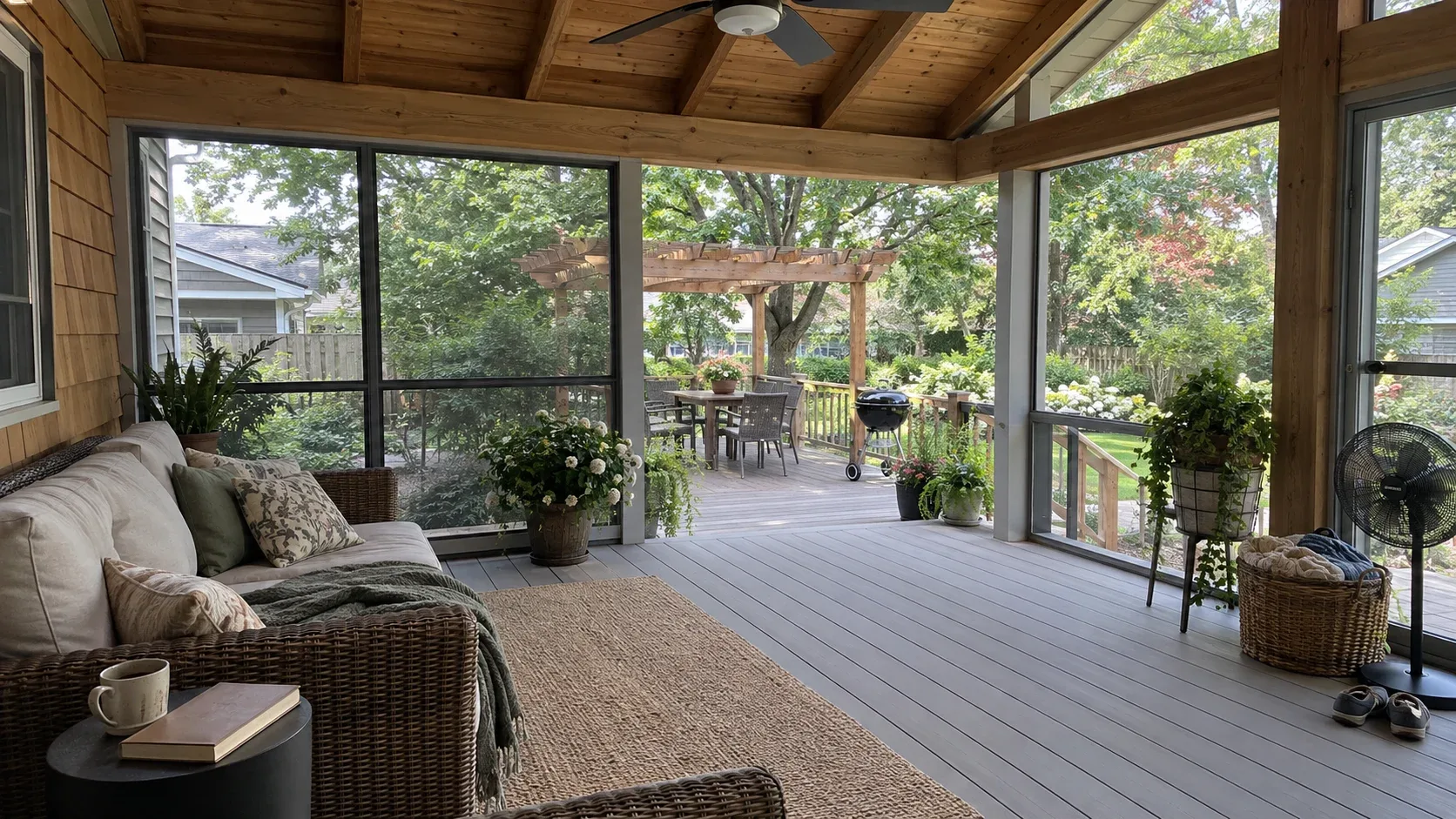
A screened porch is the structure people ask for once they have lived through a few summers under this canopy. Blue Ash has the insects and the shade to justify one, and the footprint can sit on the same pad a tired deck occupied. The hard part is the roof. These ranches have low, wide rooflines that were never drawn to receive an addition, so the tie in and the flashing decide whether the porch stays dry for twenty years or leaks into a wall.
Pergolas and shade without a solid roof
Where a full roof would darken the kitchen, a pergola gives the shade with none of the weight. On a small Blue Ash lot it is the compromise that works: open sides, a defined outdoor room, and no roof connection to solve. Cedar suits the older housing, and a painted frame matched to the trim reads as original rather than added.
Repair, guards and stairs
Not every call is a build. Deck repair here covers ledger corrections, sunken posts, stair rebuilds and railing upgrades where a guard has been out of step with the code for years. A black aluminium guard is the low maintenance answer, but a painted wood rail matched to the house trim often suits a ranch elevation better.
What we find under an older Blue Ash deck
Nailed ledgers
Decks of this vintage were often fixed to the house with nails and no flashing. From the top it looks fine. Behind the board, water has been reaching the rim joist for years, and that connection is the one behind most recorded deck failures. It is the first thing we inspect.
Posts set into the soil
Rather than on a footing with a standoff base, many were driven straight into the ground. They look solid at eye level and are soft at the ground line. In a yard with no room for a machine, lifting a deck to replace them is hand work, and we price it honestly rather than optimistically.
Guards from an earlier code
Lower than 36 inches, balusters spaced wider than the 4 inch sphere rule allows, and posts fixed through the decking instead of bolted to the frame. These are common and correctable, though the frame usually needs blocking added first.
A frame worth saving
The good outcome, and it appears often enough here to be worth checking. Where the structure is genuinely sound, new wood or composite boards over the existing frame give most of a new deck for a fraction of the cost.
Permits and review in Blue Ash
Blue Ash runs its own building department through Community Development at 513 745 8500, so the permit, the zoning review and the inspections all sit with the city rather than Hamilton County. Because the lots are small, the setback and lot coverage review carries more weight here than it does in a large lot suburb, and a layout that looks reasonable on paper can still fail the rear yard line. We check zoning before we draw.
An attached deck needs a permit. Ohio waives a state permit only for a detached deck of 200 square feet or less, no more than 30 inches above grade, that does not serve a required exit, and Blue Ash still expects the work to meet the code. We prepare the framing plan, meet the inspector at the footing and at final, and hand over the signed card.
Getting started in Blue Ash
We come out, measure, look at the house connection and the access route, and read the setbacks against what you have in mind. You get two or three layouts with prices and a written scope before anything is committed.
The deck cost guide sets out the general Greater Cincinnati ranges. Blue Ash jobs often land near the middle of them, because reconfiguration and porches use less material than a full new platform but take more planning time. If you want the local picture first, the Blue Ash service area page collects what we see across the suburb.
Deck cost in Blue Ash, OH
Pick the project, enter the size and finish, then read the installed band our estimators work from before a single call is made.
Why homeowners pick Cincinnati Custom Decks
Footings below the frost line
The Ohio River valley swings above and below freezing all winter. Every post we set lands on a poured footing below the local frost depth, which is what keeps a deck level through a decade of heave and thaw.
Permits and inspections handled
We work out which department your address answers to, pull the permit, meet the inspector and hand you the signed card. An unpermitted deck becomes your problem the day you sell the house.
Written scope before we start
Materials, framing spec, hardware, timeline and price in writing before anybody swings a hammer. No verbal change orders.
Deck questions from Blue Ash homeowners
Do I need a permit for a deck in Blue Ash?
Yes. Blue Ash issues its own permits through the Community Development building department at 513 745 8500, and the review covers zoning as well as construction. On these smaller lots the setback and lot coverage checks decide more than people expect, so we confirm what will fit at the rear property line before a drawing is made. Any deck attached to the house needs a permit. The only work Ohio exempts from a state permit is a detached deck of 200 square feet or less that stands no more than 30 inches above grade and does not serve a required exit, and even that is expected to meet the code.
Can you keep the old frame and just replace the decking?
Often yes, and it is the question worth asking before a rebuild is priced. The decking is only the surface. What matters is the ledger at the house, the joists, the beam and how the posts are founded. On a mature Blue Ash property we open the underside and look at all four. If the frame is sound and the joist spacing suits a modern board, re decking in cedar or a composite gives most of a new deck for around a third of a rebuild. If the ledger was nailed and never flashed, the wall behind it becomes part of the job whether anyone planned for that or not.
My back yard is small and close to the property line. What can I build?
Small lots are the defining constraint here, and the answer is usually a reconfiguration rather than an expansion. A deck can be reshaped within its existing footprint, the stair run can move to a better elevation, and a landing can be added without pushing closer to the line. The setback and lot coverage rules are read against the property line rather than against the house, so a design that gains two feet toward a neighbour is often the one that fails review. We measure the line first and design to it.
Will a screened porch work on a ranch home in Blue Ash?
Yes, and ranch homes take them well when the roof is handled carefully. The challenge is a wide, low roof that was never framed for an addition, so the porch roof either ties into it with proper flashing or stands on its own with a small gap. On these houses the tie in usually wins on looks. Footings go down to the local frost depth of about 32 inches and are sized for the clay, and drainage away from the posts matters as much as the structure above them.
When is the best time to book a Blue Ash deck?
Late winter is the honest answer. Permit review at the Blue Ash office moves faster before the spring rush, and a design conversation in January or February usually means a build in April rather than July. We work through the cold months on anything that does not require concrete poured into frozen ground, and with a frost depth near 32 inches those weeks are fewer than people assume. Booking early also helps on screen and rail material, which tightens up once the season starts.